By Irena Mesa
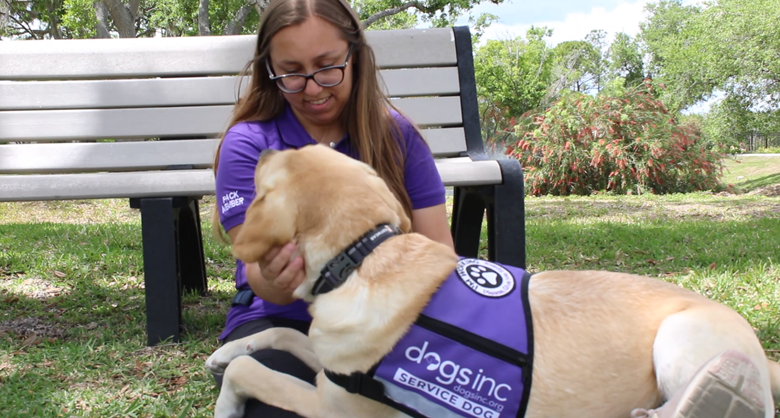
When Chelsea Aldrich was 15, she had the opportunity to shadow a guide dog trainer for a day. From that day on, she never changed her mind. Like many of the current staff at Dogs Inc., a nonprofit organization that trains and provides service and guide dogs to recipients at no cost, she started out as a puppy raiser.
Puppy raisers are volunteers who raise and train a puppy for a year and a half. They also teach a puppy basic skills and socialize them to be well-behaved and ignore distractions in public environments.
“When I was a kid, I always dreamed of raising a puppy. When I was 12, I saw a graduate speak with his dog and talk about how much his dog changed his life. After that, I had a reason to raise because before it was like, ‘Oh, the puppies are cute, this would be fun.’ But after that, I was sold on the mission,” Aldrich said.
Today, she is an apprentice guide dog mobility instructor. It takes a three-year apprenticeship to be fully certified as a guide dog mobility instructor. At the beginning, they are under nearly constant supervision while working with other instructors, and towards the end, they are on their own.
It takes about four to six months for guide dogs to complete their training at Dogs, Inc. The dogs learn landmarking, which is a prompt or cue to find a landmark like a door or curb and to travel in a straight line unless there is a reason not to do so.
“If there is an obstacle in your way or an obstruction, the dog would either stop or go around that,” Aldrich said. “We’re just teaching them mobility in the world to work with the blind person.”
To reinforce those concepts, they use a clicker, which Aldrich says works as a snapshot to the dog.
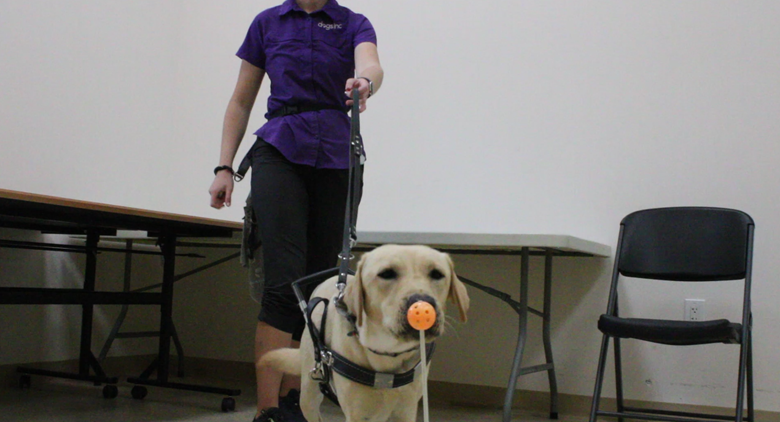
“It’s almost like a camera, and you want a snapshot of what the dog is doing in that moment. As soon as the dog does what you want, you click them and then treat them,” Aldrich said. “The clicker is always a reward, not a bribe, so I don’t want to ask a dog to sit with a treat in front of his nose, because he won’t be learning anything.”
Aldrich currently works with Arthur, a young yellow lab chosen for the guide program because of his drive and resilience in different situations. The dogs that snuggle or are drawn to the emotions of their handler are often the ones chosen as service dogs.
For service dogs, it takes six months to complete their training. Some dogs take longer, but the training is maxed out at a year. Similar to Aldrich, Samatha Phillips is an apprentice service dog instructor who hopes to be fully certified in July.
She first found out about Dogs Inc at her university’s puppy raiser club at the University of Florida.
“I started my master’s and quickly learned that sitting at a desk and doing research all day was not for me. I always knew I wanted to work with animals and something that really gives back to people as well,” Phillips said. “So, I just got sucked into UF’s Puppy Club and there was no turning back. I knew I needed to work here.”
The service dog program teaches the dogs grounding behaviors, light mobility skills, and nightmare interruption. Applicants for the dogs are veterans with post-traumatic stress disorder and Gold Star family members with PTSD. Cues or prompts such as close, shin and hug provide people with deep pressure therapy.
Other skills involve light mobility, which helps an owner use their dog for stability. Owners can also ask the dogs to retrieve items like medications if they are unable to get out of bed.
Dogs are also trained to assist in nightmare interrupts. They do this by turning on a light to help a person wake up and step away from a night terror. They do not practice the pressure therapies in this instance for the safety of the dog.
“They can flail or toss the dog off the bed. If they think they’re in a combat situation. If they start punching and kicking, that’s not safe for the dog. So, the safe alternative is that light,” Phillips said. “Just turning on the light and getting rid of the darkness is sometimes enough to help someone start to come out of it and then they can ask for those grounding skills.”
As Senior director of training at Dogs Inc., Christie Henry oversees the skilled companion and scent detection programs. She said she does a little bit of everything with the different people, dogs and departments.
“It’s all over the place because sometimes I’ll spend time with all of the different departments that I manage. Sometimes it’s hands-on working with dogs. Sometimes it’s supervising milestone tests like the blindfolds or public access,” Henry said. “There’s a lot of paperwork, way too much of the time. It’s part of the job though.”
When the dogs aren’t training, they are scheduled for downtime and extra enrichment.
“We have a ton of volunteers and a lot of them are devoted just to enrichment—that could be anything from dog massages to taking them for walks or playing with them,” Henry said. “Out of all the places I’ve worked, this is the one where I feel like the dogs are taken the best care of and we have the most volunteers to support them.”
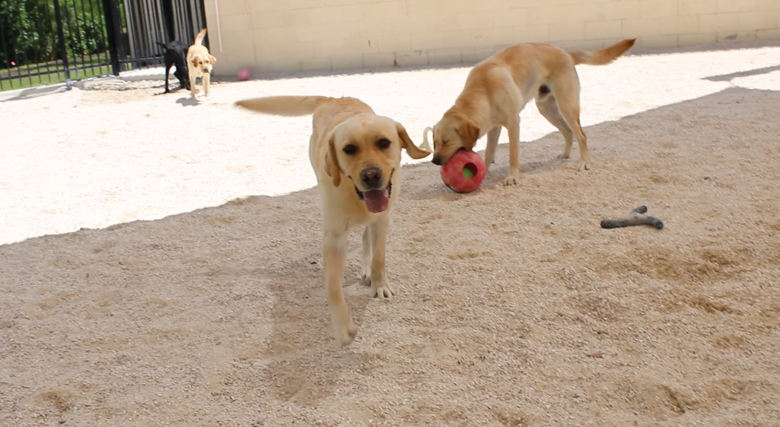
However, the work starts well before the dogs return to the main campus for their advanced training. After being born, the puppies spend a few weeks on campus before going to a puppy raiser.
Amra Dillard Rickwa supports puppy raisers and the leaders of the regional raiser clubs in her role as senior advisor. She helps plan outings and curricula for the raisers and their puppies. Another part of the job is troubleshooting when a raiser is having a hard time, as well as doing evaluations of the puppies throughout the year.
She says Dogs Inc. could not operate without these volunteers.
“They are laying the groundwork for the dog to be able to go on and do advanced training when the time is right,” Dillard Rickwa said. “There’s no way that we would have dogs that would be ready to come into college unless we had puppy raisers willing to take them in their home for a year and a half.”
Celebrating the hard work of these puppy raisers is what Dillard Rickwa says is one of the best things about her job as a senior advisor.
“We get to build confidence not only in the dogs, but the puppy raisers too,” Dillard Rickwa said, “They’re so excited to tell you, ‘My dog did this and this new thing works.’ I love being able to celebrate with that moment with them, because that’s really the heart of my job.”
Much like Dillard Rickwa, Henry, Phillips, and Aldrich all say the best part of their jobs is the human side of things, rather than working with dogs.
“There’s always one graduate that comes to mind, where just going to a coffee shop for the first time with their dog – something that’s so easy for you and I – that was a moving experience. She hadn’t done that in years, and she had tears in her eyes. That is something that dog gave to her—the ability to just sit and enjoy a cup of coffee,” Phillips said. “That’s something that we can take for granted every day, and things like that just stick with you. It helps me know that this is all worth it, and this is what I’m supposed to be doing.”
Despite the paperwork and working out in the heat during the hot Florida summers, Henry said that she is lucky to be working at Dogs Inc. and seeing people’s lives change all the time.
“I’m convinced that life has nothing better to offer than being a part of a guide dog school, because it’s all rewards,” Henry said. “There’s nothing more exciting in life than seeing a dog go through the cycle and learn the guide work to the point where they can actually guide someone who is blind.”