By Lilly Kennedy
One of the biggest hurdles a writer must overcome is the confidence to proclaim themself a writer. For many creatives, it’s a loaded and stress-inducing term that suggests an expansive bibliography and multiple works in progress. Another challenge a writer may face, especially one who is marginalized, is the opportunity to publish their writing at all.
Author and poet Sheree Greer tackled these obstacles by creating Kitchen Table Literary Arts in 2014. Greer, the executive director of Kitchen Table, felt that women of color prose writers, poets and authors lacked a community to gather, write and promote their work.
The Tampa-based organization provides a resource for marginalized authors to share underrepresented stories, access publishing resources, pursue various literary careers and gain the confidence to declare themselves writers.
“To know that 90% plus of the people who are going to read your work, champion your work, reject your work, are not going to look like you, creates a challenge,” Greer said. “I feel like I’ve been put on this planet to be a writer, and if that’s what I feel like I’m supposed to do with this one, special, wild life that I have, then I have to go up against that system. Because I don’t have any other choice.”
As of 2015, white people comprised 79% of the publishing industry, and as of 2018, 95% of published American authors were white, according to PEN America. This majority may make the idea of writing and publishing a literary work, or merely having the idea of doing either one, seem daunting.
Born in Milwaukee, Greer took a job as an IT Consultant in St. Petersburg in 2002. After realizing her calling to be an author, Greer moved away but ultimately returned to Tampa Bay in 2007.
Greer engaged with local literary scenes through hosting a queer open mic night and mingling with spoken word poets, but she felt eager to connect with fellow women of color creatives. After a futile search, she created a Yahoo group in 2012 and invited women of color authors to attend a writing workshop at the local Taco Bus.
While attendance was small, this event sparked Greer’s initiative to organize Kitchen Table two years later. The name was inspired by Kitchen Table Press, a literary community and publishing organization created in 1980 for women of color authors.
While she was determined to build a stimulating community for other marginalized authors to gather in Tampa Bay, she wanted to create an environment that a writer like herself would seek.
While she was determined to build a stimulating community for other marginalized authors to gather in Tampa Bay, she wanted to create an environment that a writer like herself would seek.
“My work with Kitchen Table is very much aligned with my work as a writer, whereas I was thinking about what I needed as a writer,” Greer said. “Especially when I first started out, not knowing anything about publishing or not knowing anything about hiring an editor. I was like, ‘There’s gotta be other folks like me who have this passion to write but have no idea what it looks like as a career.’”
Greer slowly assimilated and invited fellow women of color authors into Kitchen Table, such as a local spoken-word and slam poet, Tiffany “Slam” Anderson.
Anderson, the Community Outreach Director and Workshop Instructor for Kitchen Table, was excited to join a resource that would provide support and help her build skills in her poetry and prose projects.
She was encouraged by Kitchen Table’s mission to build a community for BIPOC women and authors who felt reluctant to call themselves writers.
“We think about the people like us. We’re building something that we wanted. We are writers who are busy, who work full-time jobs, who are doing other things, but our writing is just as serious to us as all those other things,” Anderson said. “We’re in the place where we can’t take it seriously, and maybe it’s because we’re looking for support, encouragement and empowerment to say that, you can claim that you’re a writer and take your writing and craft seriously.”
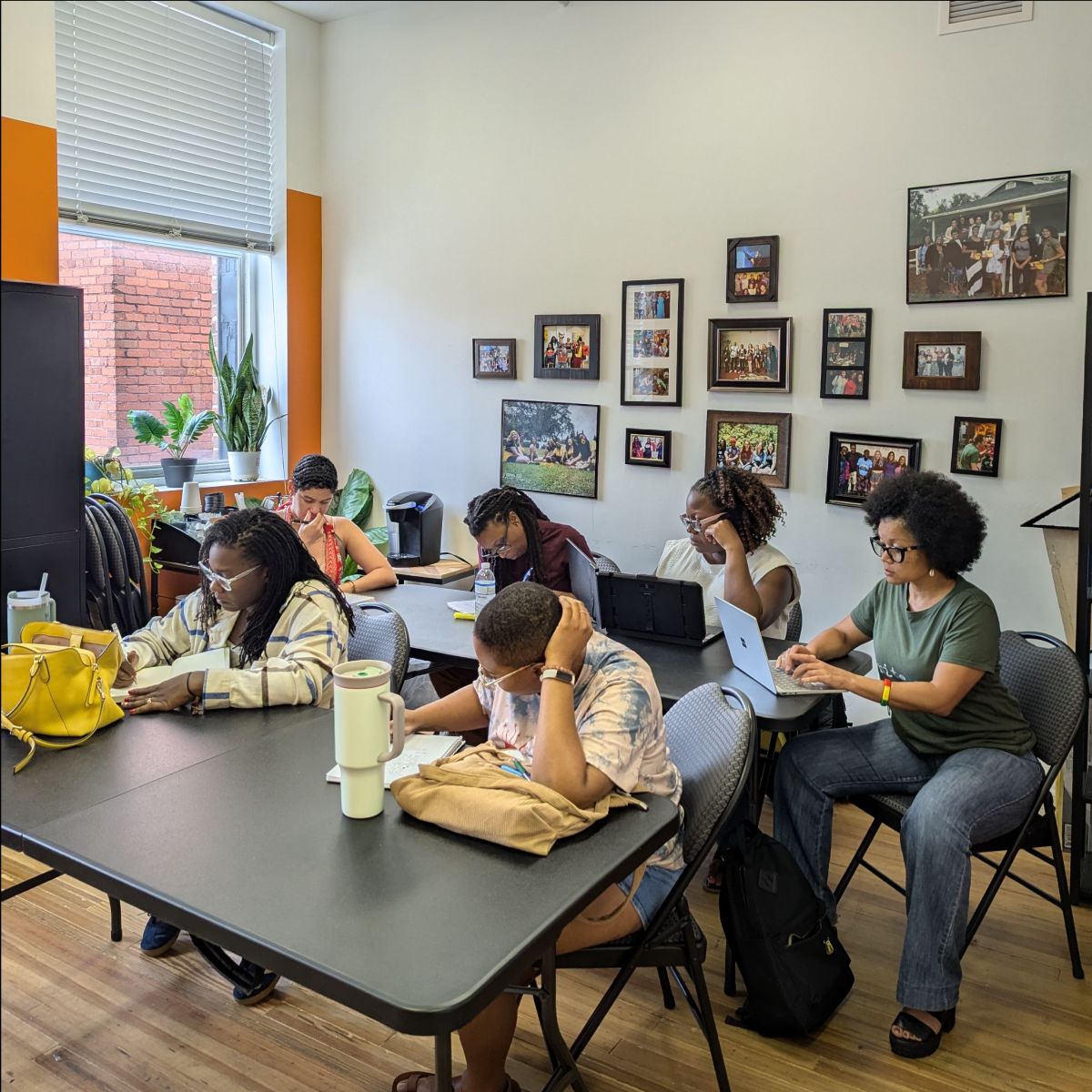
Anderson coordinates events such as workshops, literary happy hours, book series, tablings and creative writing classes. Events are held all around Tampa Bay, such as at the University of South Florida and the University of Tampa, local bookstores, senior care centers, elementary schools and residential facilities for foster children.
Maroon Stranger, a speculative fiction writer, moved to Tampa from Seattle in the summer of 2024. One of her first destinations after landing was a Kitchen Table write-in event.
Stranger, who was involved in various writing groups that met on-and-off or had few women of color authors, was encouraged by Kitchen Table’s firm and continuously engaged sense of community. She was also relieved to find a cohort of authors with a similar identity. She discovered that being in a community of writers who inherently understood the context and the core basis of her work, and not having to overexplain it, enhanced the efficacy of the feedback she received.
“Something that I have found really lovely about being in community with women of color writers is that, on the very first flush of my writing, I don’t want to have to explain so much about myself to the people that I’m sharing it with,” Stranger said. “I really have enjoyed just getting to share the story and have the people I’m sharing it with already deeply understand so much of it, so when they give their feedback, it’s already useful.”
Through Kitchen Table, Stranger has improved her craft from writing workshops and promoted her work through tabling events, such as the Tarpon Springs Book Festival. She shared her work in newsletters, increasing visibility to magazines such as “Reactor,” which voted Stranger’s short story one of the best of the month.
Stranger was also inspired by the diverse array of professional authors, editors and publishers Kitchen Table showcased. Growing up, none of the sci-fi and fantasy authors she read were women of color. Writing and publishing her work in these genres once seemed impossible. Kitchen Table proved it’s a nonzero chance.
“Whatever I see in the bookstore is whatever I see in the bookstore, but there are people like me who are getting their work out there in some way, shape or form. I found that really encouraging as well; it put a little gas in the tank,” Stranger said.
This revelation increased Stranger’s confidence in accessing publishing opportunities and reflected the heart of Kitchen Table’s mission to uplift the platforms and resources for women of color authors, editors and publishers.
Kitchen Table’s latest achievement was publishing “Our Voices, Our Community,” an anthology featuring the writing of women of color authors and poets in Florida.
Greer is hopeful for the rising generations of Kitchen Table members, the literary community that can be built throughout Tampa Bay and the change that can be enacted in the publishing industry.
“The importance (is) keeping hopeful, keeping motivated and keeping myself inspired, even though I’m going up against this big thing. You need community for that, and you also need community to help change that.”