By Sophia Lowrie
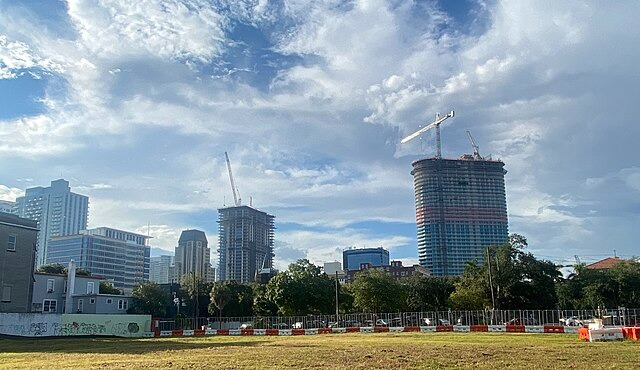
On a cloudless afternoon in South St. Petersburg, standing under a tree felt noticeably cooler than standing on bare pavement. In Midtown — one of the city’s hottest neighborhoods — shade serves as more than comfort. According to heat and climate experts, it functions as a critical form of protection against extreme temperatures.
Midtown has long been identified as one of St. Petersburg’s most vulnerable areas to extreme heat. The city’s Resilient St. Pete Action Plan classifies parts of South St. Petersburg as high‑heat zones, where limited tree canopy, dense pavement and historic underinvestment combine to create what scientists call the urban heat island effect.
Urban heat islands form when asphalt, concrete and buildings absorb and trap heat, while a lack of trees prevents natural cooling. Studies show that neighborhoods with less tree coverage often overlap with historically Black communities shaped by decades of redlining and unequal development.
“The way that cities are shaped today are legacies of decisions that were made 100 years ago,” said Christian Wells, a professor in the University of South Florida’s Department of Anthropology.
A planned expansion of tree canopy meant to cool high‑heat neighborhoods stalled after federal environmental justice grants expected in 2025 were canceled, leaving city officials searching for alternative funding. The loss raised concerns among researchers and community members who said delays could worsen health risks in areas already experiencing higher temperatures.
“There are a lot of things people might say — ‘just go inside and turn the air conditioning on’ — but if you can’t afford your electric bill, that’s not an option,” Wells said.
Data from the First Street Foundation indicates that heat exposure in St. Petersburg is expected to increase in the coming decades. Public health and climate studies show that areas with limited tree canopy and green space experience higher surface temperatures and a greater risk of heat‑related illness.
Wells described the effects of prolonged heat exposure as cumulative.
“This is what I would call a chronic condition — something that is recurring over a long period of time and then building up and increasing,” Wells said.
For many Midtown residents, extreme heat was not something to fight. It was something to manage.
Through focus groups and interviews conducted in the community, University of South Florida PhD candidate Sierra Raines found that residents had developed routines to cope with high temperatures.
Residents described small but deliberate strategies, including limiting movement during the hottest parts of the day, closing blinds to trap cooler air and reducing air‑conditioning use to lower electricity costs.
Some residents cooled their homes briefly before turning off air‑conditioning systems to avoid high energy bills. When asked what alternatives might exist, responses suggested that adaptation had become normalized.
Raines said many residents viewed heat management as an individual responsibility rather than a systemic issue.
“People are just … individualized in their thinking, like, ‘what do I need to do in order to keep my bill low?’” Raines said.
The lack of tree canopy in Midtown shaped daily experiences, particularly for residents relying on public transportation. Raines said tree canopy came up in every focus group and expert interview she conducted.
Residents described walking longer distances to bus stops with little to no shade, increasing exposure to extreme heat. Yet Raines found that connections between environmental inequality and race or income were not always explicitly recognized within the community.
“There wasn’t really a lot of acknowledgment … that the communities that don’t have as many trees are lower‑income communities of color,” Raines said.
Wells said these experiences contributed to a lack of trust in institutions.
“The biggest impact is that it erodes already delicate trust between communities and the government,” Wells said.
Expanding tree canopy has been widely proposed as a way to reduce urban heat, but the solution carries complications in hurricane‑prone areas. Raines described it as a “double‑edged sword.”
“People want shade … but they’re also worried about storm damage,” Raines said.
Some residents removed trees due to concerns about hurricanes, while others expressed emotional attachment to trees that had been part of their neighborhoods for generations. Researchers said the effects of extreme heat extended beyond physical discomfort and into broader social and identity‑related concerns.
“Being forced to divorce your identity from your lived experience makes people feel like their identities don’t matter — like they don’t matter as people,” Wells said.
Kira Rib, a Kenwood resident and researcher who worked on the Tampa Tree Canopy Study, said tree loss across the region is driven by a combination of aging infrastructure, development pressures and difficult decisions made by property owners.
“One of the challenges for the tree canopy itself is that there’s a lot of intersecting issues,” Rib said.
Redevelopment has accelerated canopy loss, particularly in neighborhoods without historic protections. Beyond development, Rib said economic constraints and safety concerns heavily influence whether trees remain.
“People don’t want to pay the cost of the maintenance or cannot afford to,” Rib said. “Over time, it’s more expensive to maintain a tree than to cut it down.”
Risk perception — especially during hurricane season — also plays a critical role.
“The risk perception of the tree might influence whether or not someone takes it down,” Rib said.
Rib faced that decision herself after moving into her home just before a major storm. After one tree fell and others leaned dangerously toward the house, she and her husband removed multiple trees due to insurance requirements.
“Even a person who does this work is going to take those trees down if they’re not properly planted and leaning over a home,” Rib said.
Despite these challenges, Rib emphasized that tree canopy remains essential for everyday life in Florida communities — especially for those without access to consistent cooling.
“There are a lot of really important uses for shaded spaces,” Rib said. “It’s people waiting for the bus, people trying to get exercise, people walking their child to school. In Florida, they’re really important.”
She added that the benefits of trees are often weighed against financial and safety risks by different groups — homeowners, renters, developers and city officials — each making decisions based on their own constraints.
“People are more concerned with the financial and damage risk than they necessarily might be about the benefits,” Rib said, “but that’s not true of everyone.”
Wells said addressing these disparities required action from those in positions of power.
“These are people who live in the communities and pay taxes, and they deserve better than they’re getting,” Wells said.
As temperatures continue to rise, delays in addressing heat disparities risk worsening conditions in already vulnerable communities.
“Because it’s a cumulative problem, it will just continue to accumulate,” Wells said.
For many residents, the most striking reality is not how extreme the heat has become — but how normal it feels.