
By Jasmin Parrado, Camila Hall, Sofia Modica, Haley Chivers and Jorge Otero

In St. Petersburg, routine police encounters now carry a new layer of uncertainty for some residents: whether a traffic stop could turn into an immigration investigation.
The city’s decision to partner with federal immigration authorities through the 287(g) program has sparked concern for the past year. Community members and advocates believe the agreement has reshaped local policing and eroded trust in the officers meant to protect them.
Andy Oliver, pastor of Allendale United Methodist Church and a prominent activist in St. Petersburg, said that residents have approached him with concerns about the agreement.
“The community is fearful,” Oliver said. “They are increasingly living in ways that are isolated.”
The 287(g) program, managed by Immigration and Customs Enforcement (ICE), allows trained local officers to perform duties that ICE typically handles, including questioning and detaining people suspected of violating immigration laws.
Critics say the agreement risks pulling municipal police into federal enforcement and discourages residents from reporting crimes or cooperating with investigations.
“Police have always historically had trust issues with marginalized communities,” Oliver said. “This does not strengthen that trust. It just reinforces distrust.”
Elizabeth Aranda, sociology professor and director of the Immigrant Well-Being Research Center at the University of South Florida, has seen how that distrust translates to inaction from the community.
According to a report that Aranda co-authored at the research center in 2025, this includes, but is not limited to, reluctance to report emergencies that require local law enforcement’s presence, forgoing medical care and refusing to testify as witnesses for court cases.
“[Residents] feel like ICE and law enforcement racially profile Latinos,” Aranda said. “Given the strong presence of ICE in these communities, many are not leaving their homes at all.”
Though newfound fear has spread across Florida’s cities, the 287(g) program isn’t new.
The program has existed in the Department of Homeland Security’s policy since 1996. But President Donald Trump’s executive order from last January, known as Protecting the American People Against Invasion, requires ICE in Section 11 to maximize the program and authorize state and local departments to the fullest extent.
As of Feb. 11, ICE has signed 1,493 Memorandums of Agreement for 287(g) programs across 40 states— Florida currently has the most. The agency’s database lists 344 agreements with state, county and municipal departments whose agreements have been signed by ICE.
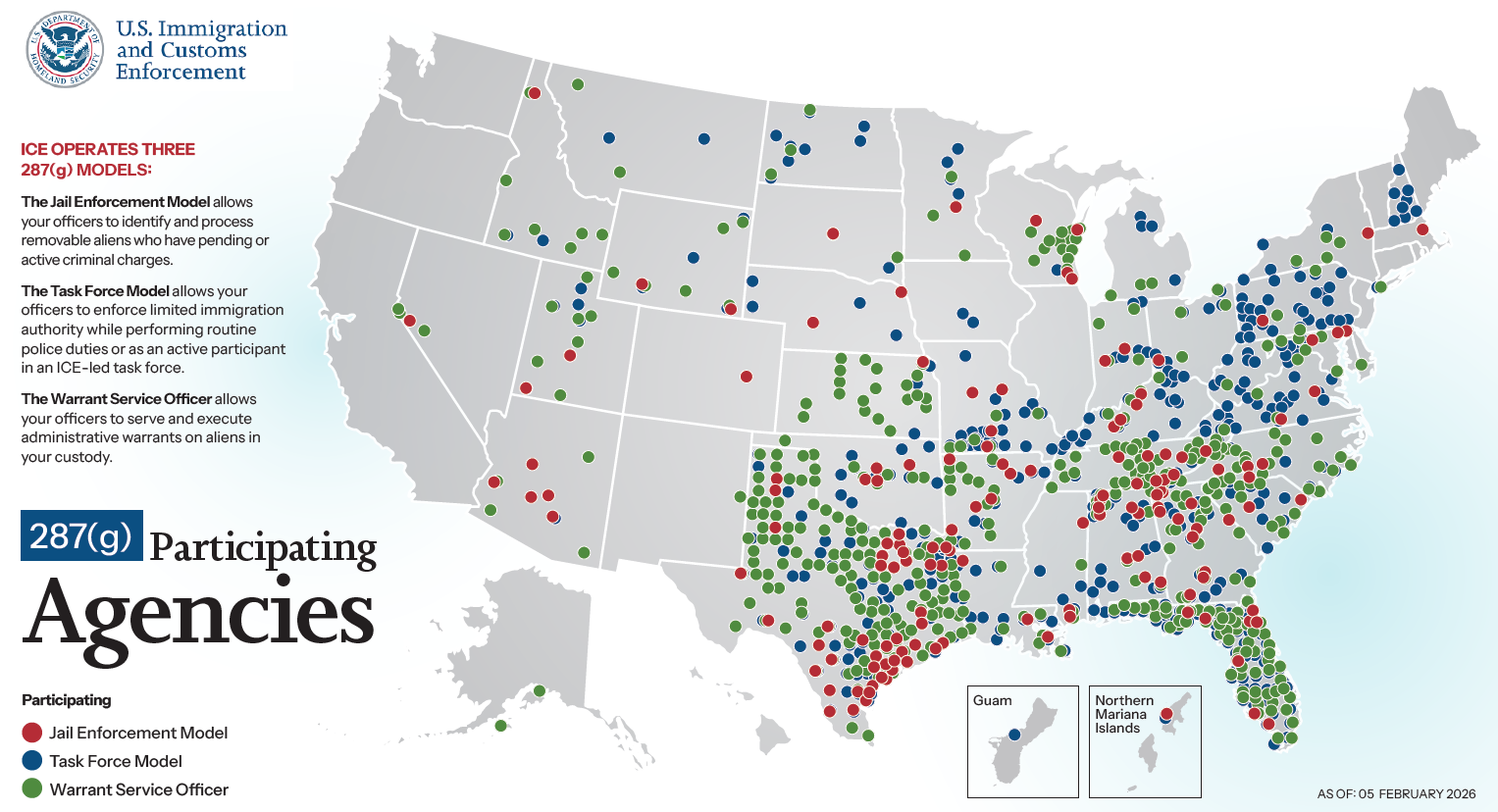
The St. Petersburg Police Department is one of those agencies. It entered the 287(g) task force model on Feb. 28, 2025, joining eight other cities in Pinellas County that signed the same day.
As a voluntary program for municipalities, this mass sign-on to 287(g) has raised community concerns about underlying incentives and the failure to prioritize the safety of residents over federal pressure.
Courtney Prokopas, Tampa Bay Immigrant Solidarity Network (TBISN) committee member, had her own speculations on the matter.“
They all signed it within two days of each other,” Prokopas said. “Nobody signs something that they have been well informed as being voluntary, as the 287(g) agreement says, unless there [were] threats of retaliation, intimidating language or something else at play.”
On Feb. 25, 2025, days before many of these agreements were signed in Pinellas County, Sheriff Bob Gualtieri sent an email to Pinellas police chiefs, suggesting that non-compliance in signing the 287(g) agreement could result in consequences.
Pinellas County Schools Police Chief Luke Williams was one of the recipients. According to Williams, a phone call between Gualtieri and the police chiefs later that evening further solidified the impression that signing onto the program was mandatory.
“As a result of that meeting, it appeared to me that there was no other alternative other than to comply with what was being relayed to the group,” Williams told the Pinellas County School Board during a workshop meeting on March 11, 2025.
That alleged narrative of pressure only strengthened backlash from residents of cities across the Tampa Bay area. Communities argue that municipalities now unnecessarily pose a threat to vulnerable populations.
At First Presbyterian Church’s Beach Drive Forum on Feb 4., St. Petersburg Police Chief Anthony Holloway addressed citizens’ concerns about who has the ultimate authority in the community when ICE and law enforcement are working together.
“The law is the law,” Holloway said at the forum. “My men and women are not going to violate the law.”
Holloway made it clear to citizens that local law enforcement is not ICE enforcement.
“I’m not ICE, we are not ICE, but we will make sure that nothing happens to them and happens to you, because you’re the people I have to answer to once they’re gone,” Holloway said.
Hannah Morgan, a St. Petersburg resident who spoke at the Feb. 4 forum, said that many of the concerns brought before Chief Holloway were related to the city’s involvement in the 287(g) program.
“I would say nearly half of the questions raised were about that,” Morgan said. “It was very palpable, the tension and the fear and concern that people had in that room. And I think that there’s a murkiness about if the 287(g) is required.”
Morgan believes that the safety of all residents in St. Petersburg matters greatly to community members—and protecting children has become an even bigger priority.
“I think it’s our duty as parents to consider the well-being of all the children in our community, not just our own, and the concept that my kids, friends or peers in their school and others are feeling unsafe at school—or unsafe on their way to school—is something no child should ever feel,” Morgan said.
According to state data on arrests and detentions, the fear Morgan has witnessed within the city is not hypothetical. The Florida State Board of Immigration Enforcement’s data tracker shows that the St. Petersburg Police Department has had 15 “suspected unauthorized alien” encounters since August 2025, and the Pinellas County Sheriff’s Office has had 324 encounters, 158 of which ended in arrests related to federal immigration charges.
Across the city, protests and grassroots activism have sparked in opposition to St. Petersburg’s involvement in the program. The weekly Pinellas Interfaith Coalition Vigil, hosted outside the Pinellas County Justice Center brings protestors together to stand for that cause.
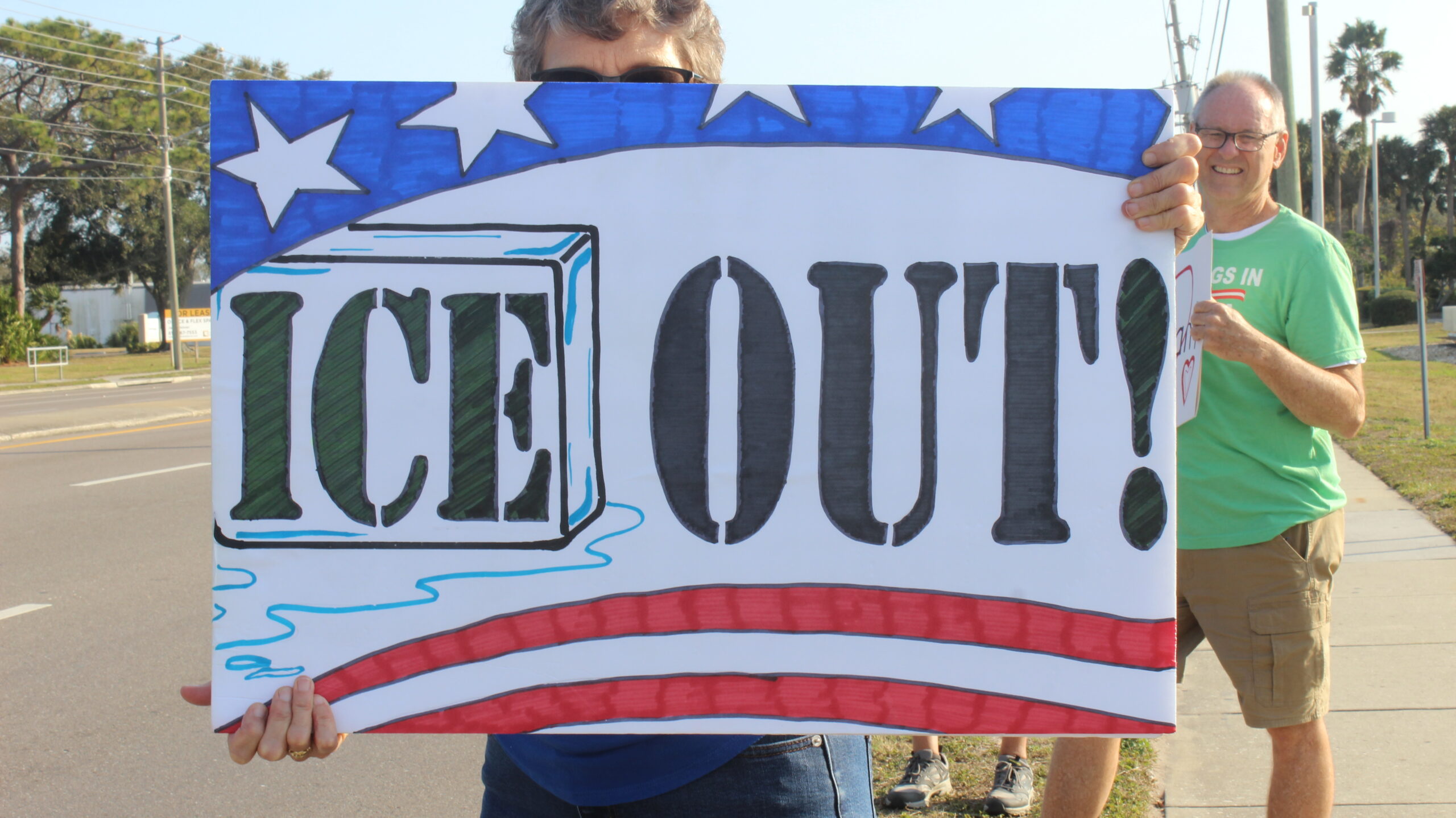
Shantel, a protestor at the Feb. 15 vigil who requested to remain on a first-name basis for protection against backlash, is originally from Minneapolis. She opened up about the movement back home that has sparked her activism in Pinellas County.
“Well, I hope we hold them as an example, you know?” she said. “I mean, the one thing about being down here is that I always missed that community and that pride in each other, us standing up for each other. We’ve always been that way, and I hope that Clearwater, St. Pete, Tampa can do the same.”
Rev. Wesley Snedeker of the United Church of Christ on Indian Rocks Beach joined the protest that day in support of a push for a united front.
“If we’re all part of a larger team, then the people who get out and yell can get out and yell,” Snedeker said. “The people who get out and pray and speak about it from a real-world perspective can get out and do that.”
Republican counter-protestor, Amaro Lionheart, made an appearance at the vigil, but he largely disapproved of the cause the protestors were advocating for.
“[The U.S.] had a lot of human rights violations happen under Obama,” Lionheart said. “And not a single one of these folks over here held a sign or had watchers and tried to get ICE abolished.”
Lionheart found the comparison of law enforcement to Nazis on some of the signs to be offensive to those affected and stripped of their humanity. He feels that the actions of ICE officers are simply reinforcing standards and laws in the U.S.
As Lionheart sees it, America under ICE is nowhere near the same level as Nazi Germany.
“That’s obviously not a current thing here,” Lionheart said. “No citizen of this country would ever allow such clear violations of human rights.”
At a small gathering that Prokopas held with TBISN at Wonderworks on Feb. 21, residents from Gulfport, St. Petersburg and other neighboring cities expressed otherwise.
Sitting down for a round-table conversation about the 287(g) agreement, attendees voiced heavy anticipation of the physical and psychological stress that vulnerable residents could face—and have—in law enforcement encounters and detention.
“[Immigrants] come to the so-called land of opportunity, land of the free, and then their temporary protected status is revoked and they’re treated as criminals just for existing, and they’re murdered on the streets,” Karla Correa, TBISN committee member, said.
Correa said that to help immigrants with their “horrible” circumstances, TBISN provides mutual aid to immigrant families, such as grocery deliveries and bi-weekly meetings outside Tampa’s ICE facility, where they provide legal and emotional support to those attending their immigration appointments.
Oliver emphasized the need for the community to hold its authority figures and elected officials accountable.
“We can look back through the lens of history and see other times when our government has operated in ways that were just unbelievable,” Oliver said. “And I think we ask ourselves, ‘How did those people allow that to happen?’ We’re seeing that right now—that the ‘something horrific’ is being allowed to happen.”