By Ashley Cline
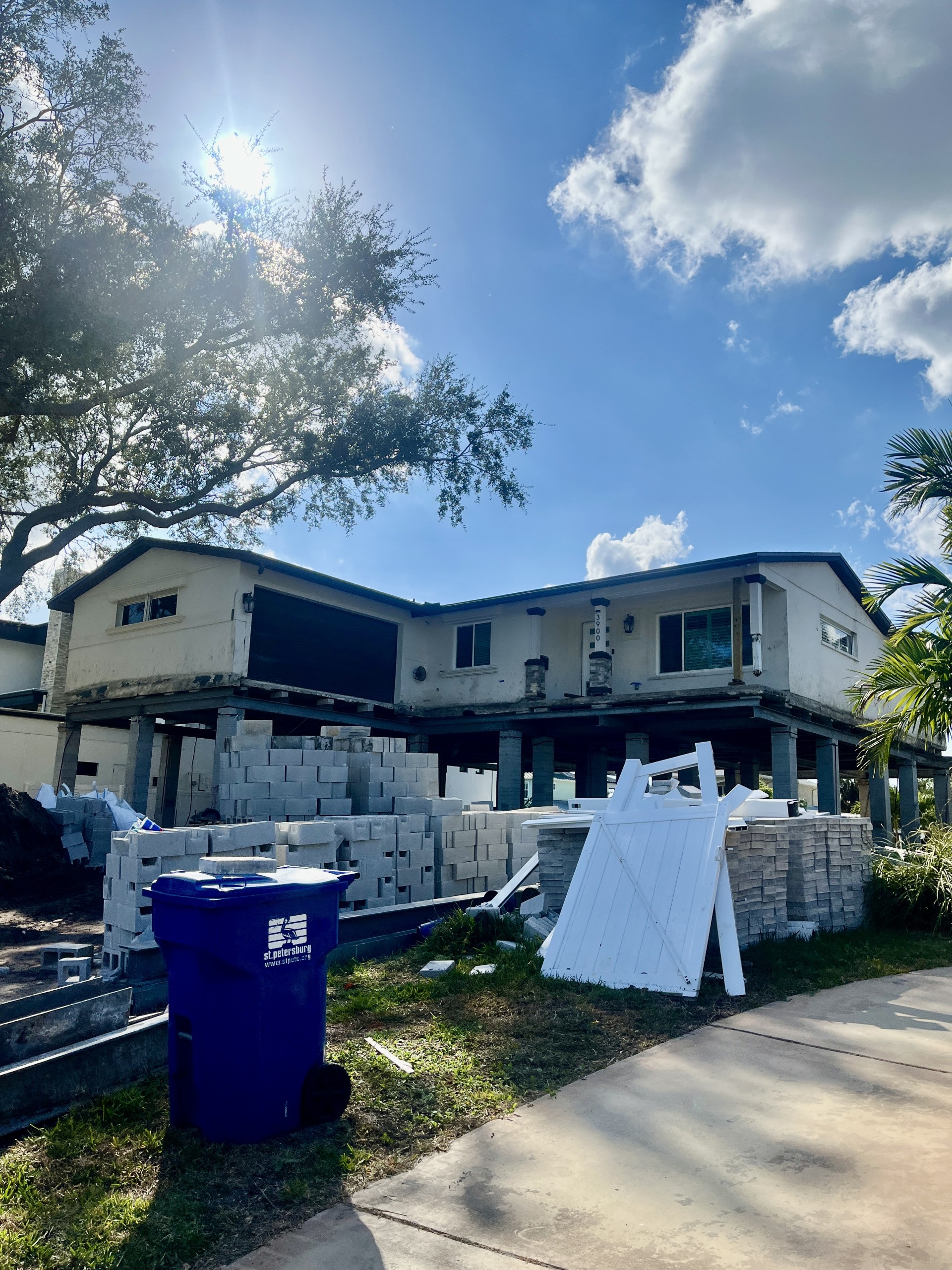
A year after the impacts of Hurricanes Helene and Milton, St. Petersburg residents in flood-prone areas continue to make important decisions to protect their property from future storm damage. While some victims of flooding chose to sell off and move to higher ground, others, like homeowner Doug Wagner, elected to elevate their homes and stay put.
Wagner had been considering renovating and expanding his beachside home ahead of last year’s hurricane season to create more space for their growing family. However, their plans for the future were fast-tracked when their home flooded.
“Me and my wife were already talking about whether we should lift the house because we’d have a lot more garage space downstairs,” Wagner said. “So I said, ‘you know what? Wworry about that in the future. If our house ever floods, we’ll do it at that point.’ And then it ended up happening.”
Wagner weighed several options before deciding to go ahead with the elevation, which gave him and his family the extra space they were looking for, additional protection from storm surge and better marketability and resale value if they choose to move in the future.
“Our neighborhood has never flooded and we’re on the beach, so maybe if I was in one of those inland neighborhoods that continue to see the flooding, maybe we would have just decided ‘let’s cut our losses here and buy something in a different area,’” Wagner said.
Realtor Taylor Todd has been active in the St. Petersburg market for four years and has seen the market trends shift in real time. Although her clients choose to buy, sell and renovate their properties for a variety of reasons, she said that hurricane activity has become a factor in the decision-making process.
“I do think there was an uptick in people that are just done with the hurricanes,” Todd said. “They don’t want to deal with it anymore. And last year those hurricanes, hopefully it was an anomaly, but that was the closest a hurricane has hit Tampa Bay and that was the most surge we’ve had.”
According to Todd, the median selling price of single-family properties in St. Petersburg has been trending down, going from $420,000 in 2024 to $400,000 this year. This trend has been exacerbated in the neighborhoods that are most vulnerable to flash flooding and storm surge.
“In neighborhoods like Shore Acres, they are taking very low offers,” Todd said. “They’re listing the houses for very low if they aren’t raising the house and are just trying to sell. But as opposed to the Crisp Park neighborhood, people are renovating and either staying or trying to sell in those areas, so it kind of depends on the neighborhood.”
For the subset of homeowners that choose to renovate and elevate their homes as a precautionary measure, Todd said that location is a top priority, as some of St. Petersburg’s most vulnerable areas are also some of the most desired for their proximity to downtown, the waterfront and beaches.
“If they love the location, if it was the first time that their house flooded, they might still say ‘let’s risk it— we want to stay in this area, but we don’t want to deal with water intrusion in our house anymore, let’s just go on and raise it,’” Todd said.
This was the case for Wagner, who said that elevation was the most cost-effective decision that would allow them to remain on the coast
“We love where we live,” Wagner said. “We were already thinking about it, and to get an elevated, brand-new home on the beach, you’re probably spending $3.5 to $4.5 million and that was just a lot more expensive compared to lifting our home.”
Ultimately, Wagner hopes that going through the lengthy construction process to remodel their “forever home” will keep their sentimental belongings and property safe from the destruction of storms to come.
“It sucks that me and my wife are having to deal with this, let alone our kids,” Wagner said. “And we’re lucky that we’ve been able to live with her parents for the last 14 and a half months. But we don’t ever want to have to do that again. It’s been very challenging, so we never want to go through it again.”
While some homeowners, like Wagner, decided to take on construction costs out-of-pocket or with insurance payouts, others looked to attain funding through a pilot program called Elevate Florida, which covers 75% of the cost of a home elevation for those approved. Kevin Batdorf, president of the Shore Acres Civic Association, said that the program is a first step towards safeguarding vulnerable Shore Acres properties from repeated flooding.
“FEMA allowed the state of Florida to create the $400 million Elevate Florida program,” Batdorf said. “It’s a statewide program, and the concept was that the homeowner should have some skin in the game, so let’s make the homeowner responsible for 25% of the cost to elevate their home. It’s the first time that FEMA has ever allowed any kind of program like this to exist.”
Batdorf said that 555 applications were submitted within the zip code that covers Shore Acres. Of those, it is expected that 100 to 150 will be approved in total. With only so much money to disperse, he said that interest across the state far exceeded funding available.
“When they rolled out the application process they expected maybe 2,000 or 2,500 homeowners would apply for it— they had 12,000,” Batdorf said. “That means 10,000 people are going to be declined by no fault of their own. It’s just that there’s just not enough money.”
Ultimately, Batdorf hopes that this temporary, relief-funded program will pave the way for a long-term funding solution to get as many homes elevated as possible.
“There’s a lot of bugs that need to be worked out because it is a pilot program,” Batdorf said, “But there’s no follow up, because this money that was used was related to disasters that had already occurred. It was left over from money that was allocated to Congress, so there’s no more money until another disaster hits. What I’d like to see is a funding mechanism that continues the process, and maybe we get 100 homes a year or every five years.”