By Leif Helland
The St. Petersburg’s Museum of Fine Arts are presenting the exclusive Longhi Foundations collection of Baroque pieces by Michelangelo Merisi da Caravaggio, as well as inspired pieces by Caravaggio.
The Longhi pieces comes from Florence, Italy, where until this year a majority of the Longhi collection hadn’t been seen in the United States, until a few years ago. Chief curator of the museum, Stanton Thomas, received a phone call from his old friend, Todd Herman, who is the director of the Mint Museum in Charlotte, North Carolina.
“Todd called me out of the blue and said, ‘do you remember the Longhi Foundation,'” Thomas said. “I said, ‘yeah, of course,” and he said ‘would you be interested in having the paintings?’ That was about three years ago.”
For the last few years, Thomas had been negotiating with the Longhi Foundation through the Civic Museum and Exhibition Company out of Florence, along with the Italian government, to get the artwork to come to the United States. After the long-awaited process Thomas was successful in getting the artwork to St. Petersburg.
“As you might imagine, bringing extremely rare and high dollar value paintings out of Italy is a long process,” Thomas said.
Thomas said his love for the Baroque movement came from film.
“I didn’t start out in art history at all,” Thomas said. “I started out in architecture, and then I went to American Civil War history. So, it was a long arc to get me here, but one of the things I’ve always appreciated, which I didn’t realize, was film. So much of film, particularly classic films, are directly drawn from Baroque. So, when I finally figured out what Baroque was, I’m like, that’s where they’re getting these dramatic stagings, these bold contrasts, these amazing compositions that are borrowed from that. And that’s something which continues today.”
The Baroque movement has been an influence on artists for over four centuries that has even included film and television. One of the most recent examples, as Thomas described Netflix’s early “Stranger Things” episode where Eleven goes into her trance state as an obvious taking from the Baroque movement.
“Millie Bobby Brown’s character, Eleven, goes into her trance state and they’re in the black like pool,” Thomas said. “They have those figures concentrated in sharp contrast of light and dark. They’re borrowing from Baroque there.”
Famous directors like Orson Welles, Ridley Scott and Martin Scorsese, to name a few, integrated
much influence of the art style into their films.
The Baroque movement style is well known for its realistic depictions of people focusing more on the dramatic aspects of life and is especially well known for its utilization of light and shadow in its pieces.
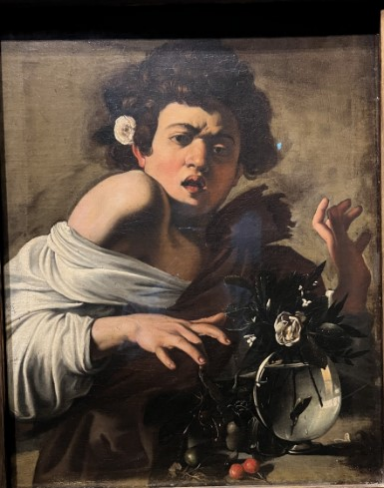
Most famously, Caravaggio’s masterpiece “Boy Bitten by a Lizard” is one of the first pieces seen as you enter the exhibit.
Attendees Josh Plotkin and Jalin Ledesma who viewed the exhibit discussed their experience.
“I’m a fan of religious art and it’s good to take a step back to appreciate it,” Plotkin said.
The artwork exhibits much detail and its use of drama as Jalin described.
“It’s very dramatic and good to take in a lot of the detail,” Ledesma said.
Much of the artwork that’s from the Longhi foundation has been kept in near pristine condition as Roberto Longhi and his wife, Anna Banti, had dedicated their lives to collecting art.
“And one of the things that’s remarkable about Longhi and his wife is they were able to buy things relatively inexpensively, not everything, but they were collecting in the ’20s, ’30s [and] ’40s,” Thomas said. “At that time, Baroque art was very much out of fashion. Because he had such a great eye, he really was a connoisseur. He could buy things very reasonably and then have them conserved. And most of the paintings in the collection are just in amazing condition.”
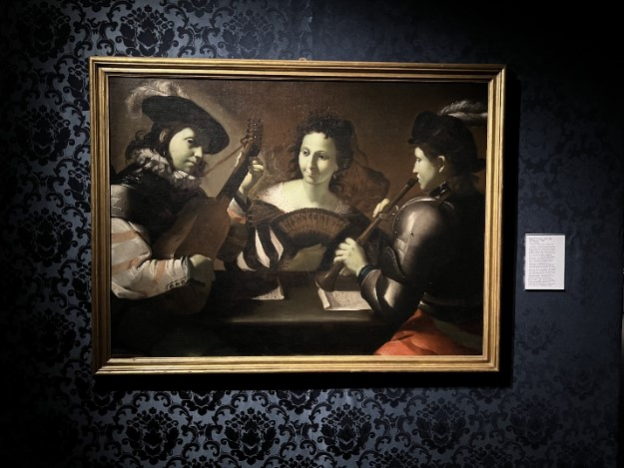
Such pieces in near like pristine condition like “The Concert” by Mattia Preti can be seen depicting people around a table playing music.
Among many of the Longhi pieces shown, a part of the Baroque exhibit brings many other artists’ pieces that were influenced by Caravaggio since his time in the 16th century.
Anything from photography, sculpture heads and sketches can be seen in one of the rooms at the museum. Thomas carefully picked this selection from the museum’s collection that he felt invoked Baroque or Caravaggio inspired qualities.