By Isabel Vega
As artificial intelligence has continued to advance and conversations regarding book banning have become more prominent, both affect literature and how it could develop over time.
Shezin Hussain, a professor at the University of South Florida St. Petersburg teaching a class on information integrity in the AI era, explained her professional standpoint on generative AI being used in and out of the classroom, especially in literature. Hussain also provided her personal opinions on how AI could affect people’s critical thinking skills.
“Somebody can give a prompt to write things, and I think I spoke to somebody the other day. They were very fascinated by the fact that AI like Jen (Jenni AI), like Claude or ChatGPT or Gemini, is helping them write thousands of pages. But that’s not your work at the end of the day, right?” Hussain said.
Hussain has also done her own research on how AI ties into how people conduct their literature works for the public.
“The copyright law itself says that any work which is generated by machines and not by humans will not be considered or not, will not be given protection under copyright law,” Hussain said.
AI has many abilities, from helping with writing and scheduling, providing medical advice, and being “someone” to talk to.
“As simple as that, it’s going to affect the livelihood of people as well, you know, because if you are doing job cutting just because AI can do half of like 10 people’s work, and how are these people supposed to survive?” Hussain said.
Alyssa Sotelo, a creative writing and English professor at USF, encouraged her students to think originally and produce original work with little to no AI use.
“I want to see your original art,” Sotelo said.
Sotelo provided her opinion on why bookstores, local or public, wouldn’t falter in the use of AI in any form of writing.
“The reason that people read and the reason that people go to bookstores is to connect to like the inherent emotion, the truth, and teaching a course called Creative Truth Telling, we talk a lot about like how truth is presented and constructed across the genres,” Sotelo said.
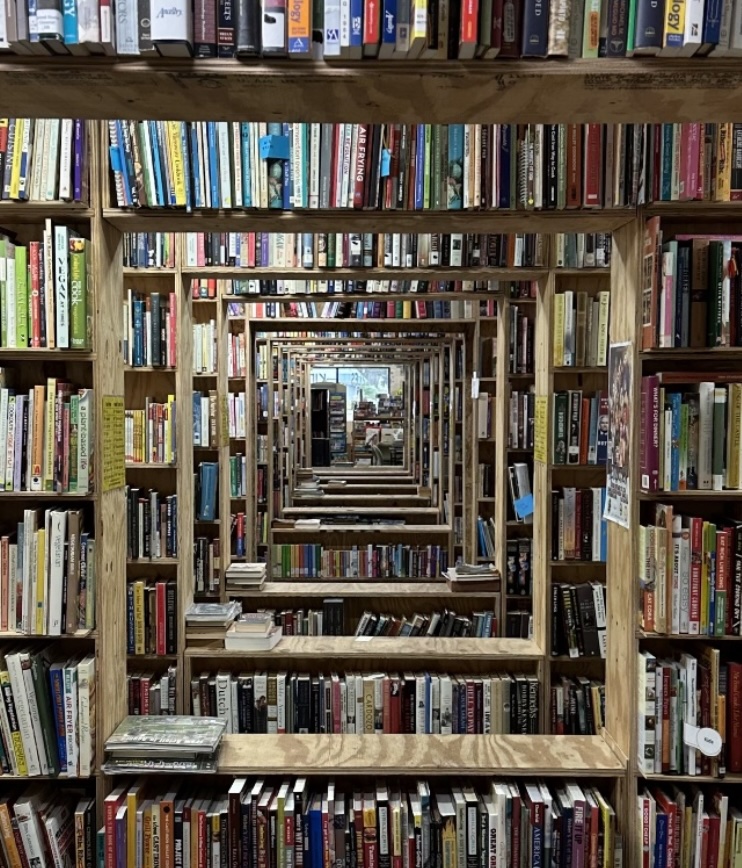
St. Pete’s local independent book shop, Book + Bottle, hasn’t seen much AI use in the local book shop community, according to Dominic Howarth, the book manager.
“There’s even like a small contingent of like, St. Petersburg local businesses who are very vocal about when they see flyers like that, or when it’s been very obvious that AI has been used,” Howarth said.
Howarth shared his thoughts on how AI could affect literature on top of human creativity.
“People want the physicality of their library because it’s something that they can protect, something that they can stand on and something that they can craft ideas with. And so, yes, it is a major danger to humanity the way AI is treating literature and ideas. But again, only if the people let it,” Howarth said. “I think it’s soulless.”
In the 2025-26 school year, almost 12,000 books were banned from schools. It has been the highest recorded banning since 2021, according to PEN America.
“It’s sad, it’s unfortunate. And the biggest impact that we’re seeing is that, like in schools, what are they allowed to teach? What are they allowed to read?” Sotelo said.
“One of the major challenges of this book banning is you don’t have to ban a book in order to take it off a shelf, you know? Like, you just have to send a challenge, and the librarians have to pull it,” Howarth said.
Local and chain bookstores created a banned book section to showcase banned books that have been taken off the shelves of public libraries.
I think there’s such an element of resistance and people are continuing to engage with banned books. A lot of classics are becoming banned. And so, people are, I think that there’s been such a resurgence in people reading classics, not assigned, just for fun,” Sotelo said.
Howarth believed bookshops can provide the escape that people need and give them a chance to let their imagination run wild.
“Bookstores are stalwart warriors, for slowness. It is asking you to stare at a wall and browse. It’s asking you to talk to a bookseller, not an algorithm, about ‘what do you like to read?’ and I think the question of ‘what do you like to read?’ is one of the most democratic and kind questions that we have in our human language. Because it is opening up an entire world of possibility, an ethical understanding of our personalities,” Howarth said. “I think bookstores are where curiosity is able to continue to play, in a world that asks you to be incurious.”